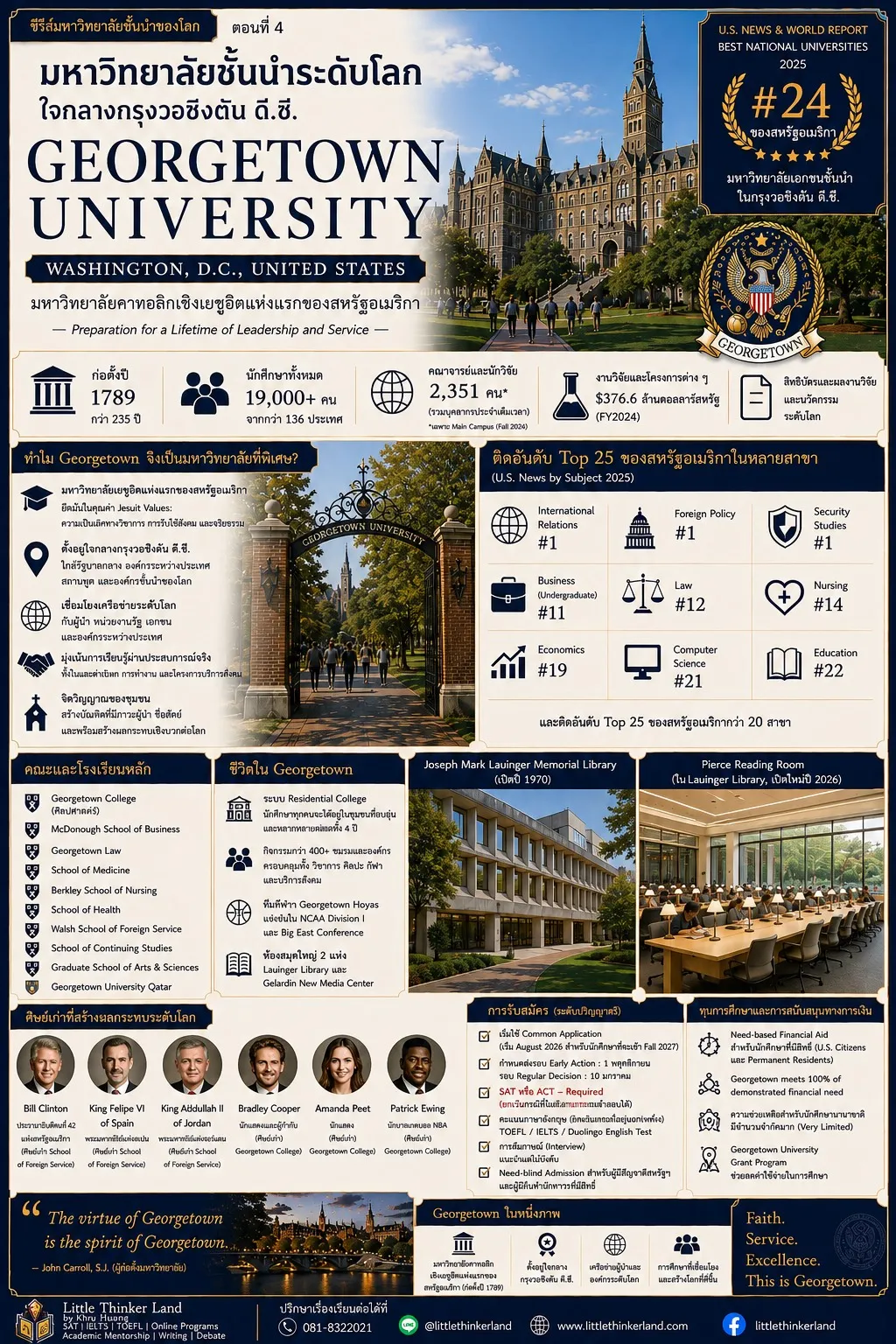
Located in Washington, D.C.—home to the White House, the U.S. Congress, numerous embassies, and major international organizations—Georgetown has naturally developed a strong reputation in fields such as International Relations, Foreign Service, Politics, Law, and Public Policy. For generations, its graduates have gone on to play significant roles in politics, diplomacy, government, and public service.
Among those who have studied at Georgetown are Bill Clinton, the 42nd President of the United States; King Felipe VI of Spain; and King Abdullah II of Jordan, along with many prominent figures from the worlds of business, the arts, and sports.
Yet what I find even more fascinating than Georgetown’s distinguished alumni is the foundation upon which the university was built.
Interestingly, many of the world’s leading universities have historical ties to religion—and Georgetown is no exception.
Founded in 1789 by John Carroll, Georgetown is the oldest Catholic and Jesuit university in the United States.
But Jesuit education at Georgetown is not simply about the study of religion. At its heart is the belief that intellectual excellence alone is not enough.
Education should develop not only knowledge and the ability to think deeply, but also ethics, a sense of responsibility toward society, and the willingness to use one’s abilities in service of others.
One of the important ideas associated with Georgetown is the concept of being “People for Others”—developing individuals who do not ask only,
“How can I become successful?”
but who also ask,
“How can my success benefit others?”
Georgetown also continues to embrace the Jesuit principle of Cura Personalis, or “care for the whole person”—an approach to education that seeks to develop the entire human being, rather than focusing solely on academic achievement.
And perhaps this helps explain why so many universities with religious foundations have continued to produce leaders, thinkers, and people who have shaped society for hundreds of years.
Because the purpose of education may not simply be to create “capable people.”
It may be to create capable people who understand what their abilities should be used for.
This is what makes Georgetown remarkable—not only because it is located in Washington, D.C., or because it has educated world leaders, but because for more than two centuries, the university has continued to place knowledge, service, and the common good alongside one another.
Its mission reflects a commitment to preparing students to participate responsibly in society and to live their lives in service to others.
Georgetown University—where education does not end with the question, “Who will I become?” but goes further to ask, “What will I do for the world?”
#littlethinkerland #KhruHuang #ครูฮ้วง #SOP #SAT