This morning, I received a phone call from a senior dean at Chulalongkorn University.
He shared a growing concern: many newly admitted students—despite earning SAT scores close to a perfect 1600—struggle to speak and write in English at the level expected in university.
This is a clear example of what many educators now recognize as “High Test Scores, Low Real-World Proficiency.” It is becoming an increasingly visible challenge for international programs across Thailand.
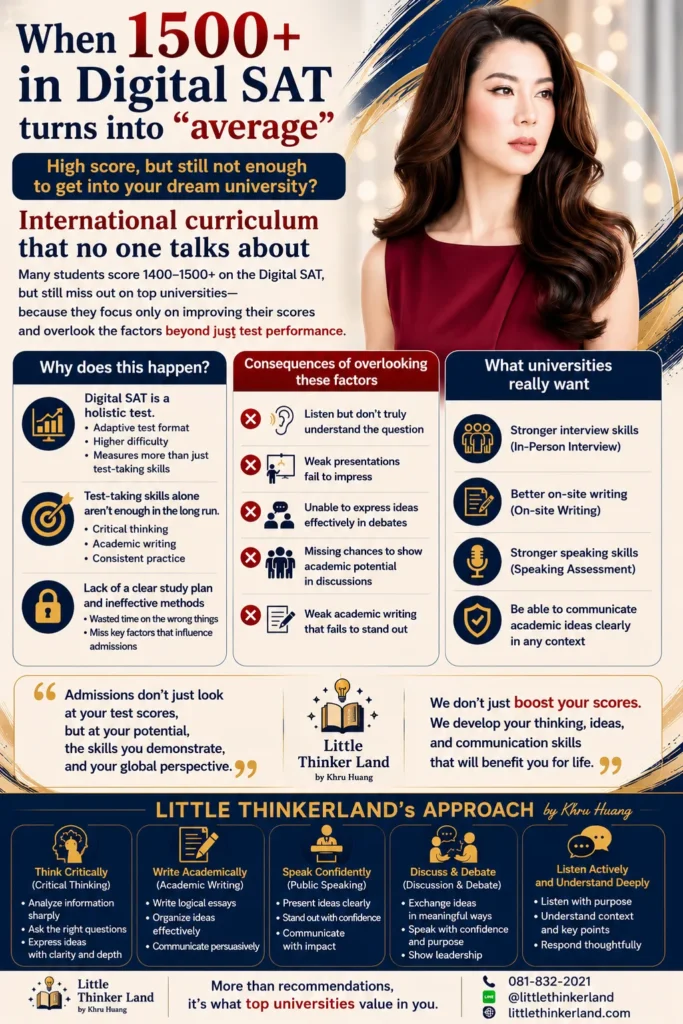
The transition to the Digital SAT—with its shorter format, adaptive testing, and increased emphasis on test-taking strategies—combined with highly pattern-focused preparation methods, has made it possible for many students to achieve scores in the 1400–1500 range without necessarily developing strong, active language skills.
And although the exam has become more accessible, there is, unfortunately, an even easier path that some choose…
Some institutions simply sell actual test questions, allowing students to achieve scores of 1550+ without earning them honestly.
As someone with a more conservative philosophy toward education, I could not remain silent. I raised concerns, submitted reports, and openly questioned these practices.
Unfortunately, no meaningful solution ever followed.
Meanwhile, students—often unaware of the long-term consequences—continue purchasing leaked materials, supported by parents who may not realize how deeply this could affect their children’s future.
When these students enter leading universities such as Chulalongkorn University, where success depends on spoken academic discourse, public speaking, debates, presentations, and critical classroom discussions, the gap quickly becomes apparent.
They may understand lectures.
They may perform well on written tests.
But when asked to communicate spontaneously, many simply cannot.
This issue is likely to reshape higher education in several important ways.
What we are witnessing today suggests that Active Communication Skills—the ability to speak, discuss, argue, and express ideas clearly—are becoming the real differentiator, far more meaningful than a number printed on a score report.
And this is no longer affecting only the most competitive faculties or programs.
This year, the impact has spread across many departments that were once regarded as among the country’s most prestigious.
Parents who think long-term—and who have both the vision and the financial means—are increasingly choosing another path: helping their children earn scholarships and continue their education at leading universities overseas.
With sincerity and years of experience,
Teacher Huang
Little Thinkerland