One of the “most in-demand” skills for students today — whether in middle school or high school — is surprisingly a skill many people think is “simple”: reading.
But in reality, reading is one of the brain’s most advanced cognitive skills.
From the perspectives of cognitive development and linguistics, “deep” or “analytical reading” is often considered even more complex than writing in many ways.
Because true reading is not just about being able to read words on a page. It requires the brain to:
- decode language
- understand context
- analyze structures of thought
- detect tone and authorial intention
- connect prior knowledge with new information
- interpret implied meanings (inference)
- evaluate logic and reasoning
In other words, the brain must simultaneously receive, analyze, and construct meaning.
Writing is certainly a highly advanced skill as well — but writers are the ones controlling the information. They can choose their words, pause to think, and reorganize ideas as they go.
Reading, especially challenging texts, requires the reader to “keep up with someone else’s thinking,” which demands a high level of working memory and cognitive processing.
Children who develop deep reading skills often become strong writers later on. But students who can write well may not necessarily know how to read deeply.
That is why the quality of writing often grows from the quality of reading. 📚✨
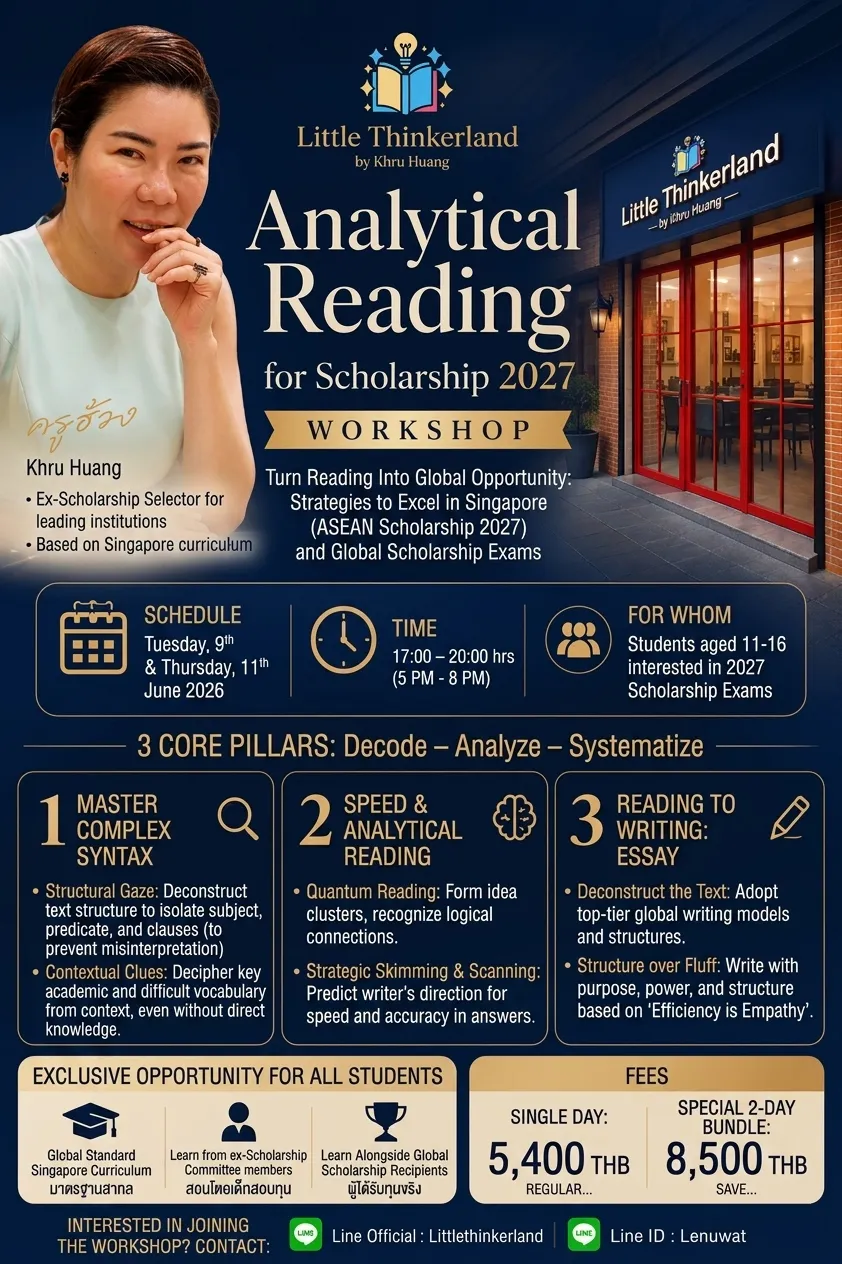
Analytical Reading for Scholarship 2027
Another workshop thoughtfully designed by Kru Huang to help students move beyond conventional reading and step into the world of systematic thinking.
#Reading #KhruHuang #ครูฮ้วง #littlethinkerland